|
To read the press releases of NMHS activities,
click here.
Source:
NMHS Newsletter, August 2018
HIGHLIGHTS
by Mary Chrastil
President, North Manchester Historical Society
Center for History Offers Free Admission
In an effort to provide even better service to our community, the Board of
Trustees of the North Manchester Historical Society voted last winter to provide
free admission to the Center for History, the museum it operates. Although the
admission charge was minimal, the board felt it might keep some of our friends
from visiting us, especially those with large families.
To help offset the loss of admission income, business supporters of the Center
have agreed to underwrite free admission for one month. The first corporate
sponsor featured in June was Poet Biorefining, followed by Wabash Electric in
July and Manchester University in August. Batteries + Bulbs, Visit Wabash
County!, the Ford Meter Box Foundation and Midwest Poultry round out the list of
sponsors. We are very grateful to these community-oriented organizations for
making free admission workable. A special thank you to Manchester University,
who designed and produced the attractive signs acknowledging this support, and
to Jack Schuler who made the lovely custom-made frames for them.
The Center is grateful to its corporate supporters for helping the Center pay
its bills, keep the doors open, offer educational programs and provide research
assistance. Free admission also helps promote businesses and tourism in our
town, something good for everyone.
Center for History staff have noticed that people are sometimes intrigued by the
museum’s window displays and want to learn more, but don’t have the time for
more than a quick visit and don’t want to pay for such a brief stay. Sometimes
visitors want to pop in for a few minutes just to see a new exhibit or check us
out, then realize there is much more they want to see. Then they plan return
when they have more time.
The Center would also like to encourage school children who visit us with their
classes each year to return with their siblings, parents and grandparents. Many
already do! The kids love to show their families what they learned at the Center
for History.
Admission has always been free for Historical Society members. It’s still free
for them, but they now generously share the benefit with others. Members often
bring out-of-town family and friends to see the Center. The members visited for
free, but the visitors had to pay. Members have told the NMHS that they are
pleased that their visitors can now visit for free, too.
The Center for History has become a trusted institution in North Manchester, one
that loves telling the story of our town, why we are here, and how we got to be
who we are. With free admission we can now tell our story even more effectively.
Center for History Repeats Grant Success
In 2017, the Center for History gratefully received a $50,000 Heritage Support
Grant (HSG) from the Indiana Historical Society for new LED lights throughout
the museum. The lights protect our artifacts from harmful UV rays, reduce our
electric bills and transform us into a more professional-looking space. We also
received $4,545 from HSG for a double-insulated replacement roof over our leaky
barn room. This work will help protect our building and artifacts from water
damage and also save on heating costs. Both were highly competitive grants.
We were lucky enough to repeat our success this year. The Center has just been
notified that it has been awarded a $45,700 HSG to increase museum security and
artifact safety by:
· Providing security cameras that will help us deter theft and damage.
· Installing a fire alarm system that will send alarms if smoke or fire
occurs, especially helpful when the building is unoccupied.
· Replacing defective fans to control heat and humidity. Our HVAC systems
have been upgraded and we monitor heat and humidity levels frequently, but we
still need to have proper air circulation to bring heat and humidity into
acceptable ranges for artifact preservation.
· Installing a new furnace and air conditioner in the Thomas Marshall
House museum.
The Center for History also received a $5,000 mini-grant to repair a crumbling
wall in our foundation. The deterioration was discovered when paneling in the
oldest part of the building was removed for routine repairs.
We are very grateful for this support, especially because funding for
infrastructure is rare. The Historical Society must raise a 15% match for the
grants, but is happy to do so for such a generous gift. The work funded
was not possible without support beyond our normal operating budget.
Ogan’s Landing
This year, the NM Historical Society campaigned to name North Manchester’s new
kayak and canoe launch Ogan’s Landing. The Parks and Recreation
Department asked residents to suggest a name for the site, and Historical
Society members responded!
Brothers Peter and John Ogan bought land in Wabash County in 1835, and soon
showed the ambition and entrepreneurial skills that have marked our town from
the beginning. Peter is regarded as the founder of North Manchester. He is not
the first non-Native American settler or the first to purchase land here. But he
was the first to build a cabin and the first to hold church services here in his
home.
Most importantly, Peter purchased land where North Manchester now stands. He
platted the town, having it surveyed and laying out the grid of streets and
building lots. The most remarkable thing he did was plat the major streets to be
100 feet wide. Very few towns have lovely avenues like our Main Street, Mill
Street and Market Street, a lasting legacy from Peter Ogan.
Records show about half a dozen others helped build Peter’s cabin in spring,
1836, which was on the banks of the Eel river at 125 E. Main Street. Records
show that at that time, the river was 130 feet wide. Other early families here
were the Helveys, Harters (Harter’s Grove), Weybrights and Swanks.
Most early settlers built mills the first thing. Otherwise they had to travel
for miles to get flour. Peter built a flour (grist) mill just north of today’s
canoe launch.. Peter also built a saw mill nearby, another early priority. An
1837 map shows the location of the mills along a mill race that was dug to power
the mills that were at the foot of the current Mill Street (hence the name Mill
Street).
Early settlers often came to exploit the natural resources of an area, which
meant lumber. They also purchased the land to speculate, selling it fairly soon
and making a large profit. They often moved on fairly quickly. So did Peter, who
moved on to White and then Tippecanoe Counties. His family never entered into
marriages with other early settlers. But his legacy remains in the streets we
still use today.
John Ogan did stay around. He, too, built a cabin and a mill, this one a
“cracker” mill that ground corn into a coarse consistency. His mill was on the
south side of the river where Pony Creek empties into the Eel. For many years,
Pony Creek was known as Ogan’s Creek. John Ogan family members continue to live
in North Manchester. Some of them are the Joe and Mary Vogel family, their son
Jim, his wife Erica and grandson Jacob.
Traveling Exhibits
As it does every year, the Center for History has continued to take advantage of
interesting and informative traveling exhibits offered by the Indiana Historical
Society. The Center is recognized as the local site where these
professionally-designed exhibits are available on a regular basis. You don’t
have to go all the way to Indianapolis to see them!
We are currently exhibiting “Indiana through the Mapmaker’s Eye”, which will be
here through September 14. The exhibit is drawn from IHS’s collection of about
1,700 maps and atlases of Indiana and the Midwest dating from the 16th century
to the present. It examines ways people have used maps through the years: as
documentation, as tools, as political images and as art.
From September 14 through October 16, the Center will host “Who Is a Hoosier?”
The exhibit uses maps and informational graphics to highlight the statistical
impact of changing ethnic groups over time. It shows how newcomers to the state,
through immigration or migration, have created the Indiana we know today—and
will continue to shape its future.
Excursions
The NMHS arranges tours each year in conjunction with the NM Shepherd’s Center.
Board Member Bernie Ferringer is in charge of the tours. In June, 2017, tour
participants visited Stratford, Ontario to enjoy four plays presented by the
Stratford Shakespeare Festival. In December, we traveled to the Purdue Christmas
Show. In June, 2018, travelers enjoyed a trip to Milwaukee and Door County,
Wisconsin.
Coming up in April, 2019 is a visit to Williamsburg, Virginia and Lancaster and
Johnstown, Pennsylvania.
Contact Bernie Ferringer for information if you would like to join our next
trip: Bernie Ferringer, Tour Coordinator, 314 Sunset Drive, North Manchester,
In. 46962. Phone 260 982-8734.
Collections and Exhibits
Since moving into the Center for History in 2000, the museum’s collection of
artifacts has grown from 2,200 items to almost 30,000. About 1/3 of the items
are three dimensional, 1/3 are photographs, and 1/3 are other documents.
Some of the interesting items we have recently acquired from donors are:
· Civil War Era clothing: dresses and three mourning hats
· Photos from the Oppenheim hosiery sale, 1945
· Bronze plaque commemorating the death of Old Order Elder James Quinter
at the church’s annual conference in North Manchester in 1888
· 1932 wooden Mickey Mouse doll
· 26 Story Book Dolls with original polka dot boxes
· Score board from North Manchester Central High School
· Replica horse-head hitching post, originally located in front of
Oppenheim Store
· Lutheran pastor and author Hugh Wells scrapbook
· Kroger “Top Value” stamp books with stamps
· Chairs (4) from the Hamilton Opera House, c. 1880
· Civil War sword and bayonet
· Mounted head of white-tail deer, 11 points
Historical Society Honors Volunteers
Approximately seventy-five volunteers to the North Manchester Historical Society
and North Manchester Center for History are honored in April every year to
celebrate National Volunteer Month. The volunteers serve as docents,
researchers, exhibit planners, exhibit fabricators, artists, Thomas Marshall
House docents, board members, program planners, school day volunteers,
administrators, and in many other capacities. NMHS is a virtually all-volunteer
run organization, so it is deeply grateful for volunteer support.
Volunteers provide the equivalent service of 3 to 5 Full Time Employees each
year. Total volunteer hours since the Center opened are 78,833. Using the
guidelines provided by The Independent Sector volunteer website, the 78,833
hours translate into volunteer services valued at $1,857,305. In other words,
Historical Society volunteers have donated 1.86 million dollars of service since
the Society began keeping records in 2000.
Volunteers who have accumulated 100 hours of service received a polo shirt with
the North Manchester Center for History logo. Those achieving this milestone in
2017 were Kay Barnett, Kathy Prater, Jack Schuler and David Waas. Joyce Mills
and Mary Ann Swihart reached the milestone in 2018.
Volunteer of the Year awards are also given annually. The Volunteer of the Year
awards were given to Nancy Schuler and Jack Schuler in 2017 for Nancy’s work as
a docent, volunteer data base manager, and bookkeeper and Jack’s service on the
Center’s Building and Maintenance Committee and his hands-on repair and
carpentry projects. In 2018, Volunteer of the Year awards were given to Joe
Vogel and Joan Fahs. Joe has been on the board of trustees of the Center for
History since the group was organized. He is currently on the Center’s
accessions, planning and job search committees and has helped with scores of
projects through the years. Joan has been one of the Center’s most faithful
volunteers. She is a docent, maintains our file on obituaries and “always says
yes” when a volunteer is needed.
Travel Tales
By
Bernie Ferringer
The North Manchester Historical Society/Shepherd’s Center travel group recently
traveled to Racine, Milwaukee and Door County Wisconsin.
We left N. Manchester Wednesday June 20th for
five days and four nights in
Wisconsin. First, we made a
surprise stop at the Albanese Candy Factory near Merrillville IN.
We were not able to take a tour but everyone found their favorite candy
to take on the trip or to share when they got home.
There were 52 travelers leaving only two empty seats, a really great mix
of people that have traveled with us before and first-time travelers.
I don’t think anyone went hungry during our trip, our evening meal on Wednesday
was at the Hob Nob Supper Club. One
of the choices was a 14oz. pork chop that I don’t think anyone finished.
On Thursday our first stop was at Lehmann’s Bakery for a demonstration on
making Kringles. Very informative
and we all enjoyed the samples and fresh baked cookies in our honor.
Many boxes of Kringles went home with us on the bus.
Latter that morning we had a step on guide for a tour of Racine.
After lunch on our own in downtown Racine we went to the S.C. Johnson
complex for a tour of two buildings designed by Frank Lloyd Wright, very
interesting. That evening we
traveled to Ft. Atkinson, WI for a great buffet at Fireside Dinner Theatre
followed by a hilarious production of “A Second Helping”.
On Friday we traveled to Milwaukee to meet our step on guide who did a great job
of showing and telling us about Milwaukee.
Following the tour, we went to the Harley Davidson Museum for a history
lesson and tour about Harley motorcycles.
This was followed by lunch on our own at the Harley restaurant.
We then traveled to Ellison Bay in Door County for a two-night stay at Rowelys
Bay Resort. This is a very nice
resort hotel on Lake Michigan. Our
first night we were treated to the traditional Fish Boil with the history of the
area and what a fish boil is by the resort chef and a local historian.
On Saturday we had breakfast at Al Johnson’s Swedish Restaurant, known for the
grass roof with live goats walking around and feeding on the roof.
Breakfast was Swedish Pancakes, sausage, juice and coffee, all very good
and tasty. We then boarded a
ferry to Washington Island for a tour of the island on the Cherry Train,
followed by a sit down lunch on the island.
After arriving back in Ellison Bay, we had free time to wander Main
Street to check out the shops or sit on benches at the harbor and watch the
boats coming and going. That evening we were back to the resort for a wonderful
buffet meal.
Sunday morning we checked out of the resort and traveled to Fish Creek.
In Fish Creek harbor we boarded a boat for a tour of Fish Creek.
Our docent on board did a great job and told us a lot about the history
of the area. We then boarded our
bus to start our return trip to N. Manchester. Another unplanned stop was at
Renard’s Cheese shop. We had a
great time looking at all the different cheeses as well as tasting several.
Many shopping bags found their way onto the bus as we were leaving.
Thank you to everyone that joined us on this trip. It was great to see the
veteran travelers make the first timers feel welcome and a part of the traveling
family. Everyone was on time and
didn’t complain about our fast-paced schedule.
Source:
NMHS Newsletter February 2018
North Manchester Historical Society
Activities in 2017
By Mary Chrastil, President
Hidden Highlights
Every year, I try to relate key events of the past year to our members and
friends. 2017 was a memorable year. The main new accomplishments this year were
in areas that people may not notice.
New Museum Lighting System.
The biggest accomplishment for the Historical Society this year was replacing
the lighting system throughout the Center for History. We replaced fluorescent
lights that give off damaging UV rays with LED lighting. UV rays cause any
organic materials—wood, cloth, paper, etc.—to deteriorate slowly but surely. We
were fortunate to receive a $50,000 Heritage Support Grant from the Indiana
Historical Society through a program funded by the Lilly Foundation. It required
a $7,500 match, which the Community Foundation of Wabash County graciously
provided. Wabash Electric Supply, Inc. helped tremendously with a $5,000 pledge.
Wabash Electric also applied for over $5,300 in rebates for us from the Duke
Energy Smart Saver Rebate Program that encourages the purchase and installation
of high-efficiency lighting. With all this support and with some careful
planning, we completed the project at no additional cost to the Historical
Society.
When we got the grant, we knew we’d help preserve our artifacts better and that
we’d save on electricity. But what surprised us was how the new lighting
absolutely transformed our museum. Rather than relying on general lighting that
treated all areas equally, we’ve been able to focus attention on important
displays that had sometimes been overlooked in the past. Areas that had been in
shadow are now easy to see, with labels that are easy to read. The “traffic
flow” pattern in the museum has improved. Safety has been enhanced. Staff and
volunteers have been inspired to update and improve exhibits.
Additional thanks go to Wabash Electric Supply for designing the systems and
handling all the orders and deliveries, to Riverbridge Electric for installing
the new lighting, and to SRKM Architects who helped with the initial planning.
Center for History staff Paula Dee and Joyce Joy were heavily involved at all
stages of the project. Mary Chrastil secured the funding. And super volunteer
Jeanne Andersen oversaw the project for the Historical Society. She did
everything—from planning, making sure that the work was done correctly, and even
climbing on very tall ladders to position spotlights and floodlights for the
greatest effect.
Everyone notices the change. One enthusiastic visitor told us we look so much
more professional now, “like a real museum.” If you haven’t visited the Center
for History since last summer, please come and see the new lighting system, and
enjoy new and enhanced exhibits. The project turned out even better than we had
imagined it would.
Roof Repairs.
Besides the new lighting system, we completed several projects that are even
less noticeable but are crucial to our functioning as a museum. We were able to
repair a leaking roof over our barn exhibit area, again with the help of grants
from Indiana Historical Society and the Community Foundation of Wabash County.
As part of the roof repair, we added thick layers of new insulation, which we
expect to result in significant energy savings.
Environmental Monitoring.
Heat and humidity fluctuations are key causes of harm to artifacts, along with
ultraviolet light rays. As part of our mission to collect and manage artifacts
reflecting local history, we need to ensure that artifacts are held within a
specific range of heat and humidity. To help us create an optimal environment,
we purchased 15 heat and humidity monitors that were placed throughout the
building in areas where artifacts are displayed and stored. We take readings
several times each week. Based on this monitoring, we expect to improve our
heat/humidity environment even more in 2018.
Administrative Reorganization.
When an organization moves from a startup mode to a more established operation,
different skills are needed to thrive. This is most important in an organization
like the Historical Society, which relies mostly on volunteer involvement. To
expand our skill set and develop our human resources, we have been strengthening
several existing committees and creating new ones.
This year, we strengthened committees on Programming, Nominating and Building
Maintenance. Thank you to members of the Programming Committee that plan and
implement the monthly programs at Timbercrest: Barb Amiss, Tom Brown, Mary
Chrastil, RuthAnn Angle, Joyce Mills and David Waas. Thank you to Jack Schuler,
Al Schlitt, Dave Randall, Tim Taylor, Bernie Ferringer and Joe Vogel who
volunteer on the Building Maintenance Committee, and Tim Taylor, Tom Brown and
Mary Chrastil on the Nominating Committee.
We also established committees on Finance and on Planning. Thank you to Matt
Mize, Nancy Schuler, and Tim Taylor on the Finance Committee, who are reviewing
and documenting our financial procedures, and Tom Brown, Debbie Chinworth, Paula
Dee, Jim Myer, Kathy Prater and Joe Vogel on the Planning Committee. In the
coming year we expect to establish an Audit Committee and a Communications
Committee.
Finances.
2017 has been a challenging year as we re-established our financial reporting
system, disrupted by the loss of treasurer Ralph Naragon, who handled our
finances for about 25 years. New treasurer Matt Mize has filled that position
admirably, working with President Mary Chrastil to rebuild and streamline our
financial reports. We ended the year on solid financial footing, making up some
of the shortfall caused by the façade restoration last year. We sold the house
we owned on behalf of the Historic Homes Preservation Group and dissolved that
relationship. With the help of our loyal members and donors, we feel confident
that we will replenish our reserve funds over the next several years.
The grants mentioned earlier helped our bottom line, along with being one of the
recipients of the Wabash Cannon Ball Chili for Charity Cookout. Grants,
memberships, our annual fund donor response, and careful management of expenses
allowed us to make considerable improvements in our building while still
fulfilling our core activities.
North Manchester Documentary and Oral History Archive
The title of the video is A Sense of Place, taken from the name of an
important local history written by Ladoska Bunker in 2000. The project began as
an update to See Yourself in the Movies, the movie documentary on North
Manchester created in 1938. Besides updating the earlier documentary, A Sense
of Place explores how the town has been represented in visual media in the
past. It also has an expanded section on early North Manchester history so it
can be used as a teaching tool for Indiana History students.
More than 30 town residents were interviewed over a period of several years for
the documentary. The interviews provided much more material than could be used
in one video. The Historical Society is delighted that the full interviews will
be added to its collection to provide a contemporary oral history of North
Manchester. For years to come, scholars will be able to tap this valuable
resource to learn about the strengths and challenges of our town.
The film was shown at the Historical Society’s Annual Meeting in January, 2018,
and will have a “Premier Party” later this spring. Thank you to James R.C.
Adams, who recorded the interviews, culled through hours of tape to distill the
most appropriate selections, edited the copy, and contributed to the script; to
Charles Boebel who researched and wrote the script and led the interviews; to
Joyce Joy who contributed to the research; and to Mary Chrastil, who organized
the project and participated in the interviews.
On-Going Projects
Museum Operations.
In 2017, the Historical Society and the Center for History continued with
activities that we perform every year. We operated the Thomas Marshall House
Museum, with visiting hours on the first Saturday of the month from March
through November and on special occasions like Funfest and Harvest Festival. We
also extended free admission to both museums and planned special activities
during town festivals, to the delight of hundreds of visitors from near and far.
Besides our regular Center for History hours from 10 a.m. to 4 p.m. Monday
through Friday, we participated in several special Saturday openings to support
Manchester Main Street and Chamber of Commerce promotions.
School Programs.
We continue to host second and third grade students from the Manchester
Community Schools. We get high marks from teachers and parent chaperones for our
school programs. Students had fun and learn a bit about their town as they
rotated through learning stations throughout the Center. Many later bring in
their parents and grandparents to show them what they learned.
Collections.
Our collection of local history artifacts continued to grow, reaching over
29,000 items. We receive about 1,000 artifacts each year. About one third are
photographs, one third documents, and one third three dimensional.
All artifacts are managed using the professional museum standards.
Educational Programs.
Our public programs are held at Timbercrest Retirement Community on the second
Monday of each month and continue to attract an average of 100 people every
month. Programs in 2017 ranged from
an interpreter appearing as Thomas Lincoln, to the stories of Liberty Mills
founder John Comstock, early pioneer women of Huntington County, a trio of
lesser known First Ladies, and Indiana pioneer diaries written during their
emigration to California in the 19th century. Programs also featured the work of
the Indiana Landmarks organization, the Indiana War Memorial in Indianapolis,
the history of the Indiana Dunes, the Potawatomi Trail of Death, and the history
of Manchester University’s interactions with the town of North Manchester.
Community Outreach.
The historical society continued its quarterly newsletter with scholarly
articles and news of coming events. We also have a robust presence on Facebook
and frequent visitors to our website. We continue to make our presence known in
the community with speaking engagements; this year we hosted a Trolley Tour of
North Manchester arranged by Visit Wabash County! The Historical Society
participates in the Manchester Main Street Preservation and Design Committee,
and works collaboratively with community organizations like the North Manchester
Public Library, Chamber of Commerce, Visit Wabash County!, Shepherd’s Center,
Manchester University and the Manchester Community Schools.
Excursions.
This year, the Historical Society organized two trips in partnership with
Manchester Shepherd’s Center. In June, the group traveled to Stratford, Ontario,
to attend the Stratford Shakespeare Festival, enjoying four Festival plays and a
dinner theater production. Shopping and visiting local attractions during
Canada’s 150th Anniversary celebration completed the tour.
In December we led a tour to the Purdue Christmas Show, a trip we arrange every
other year, and ended the evening with dinner in Kokomo. In June, 2018, a tour
to Door County, Wisconsin, is planned. At this writing, a very limited number of
spaces is available if you wish to join this trip.
Thank you to Bernie Ferringer for leading the trips and to Vicki for helping
out!
Source: NMHS Newsletter, August 2013
Nancy Reed Resigns;
Search Underway for Museum Director
By Mary Chrastil, President
After 6 years of service, Nancy Reed has resigned as Director of the NM
Center for History. Nancy joined
the museum staff in 2007. However,
she has given many past years of service to the NM Historical Society, serving
as past president, vice president, secretary and treasurer.
Nancy was deeply involved in helping purchase the Thomas Marshall House
and moving it to its present location.
At the Center for History, Nancy has been responsible for securing,
training and assisting docents, staffing the front desk when volunteers are not
available, creating exhibits, creating popular displays in our front windows,
managing our gift shop, arranging programs for elementary school students, and
managing the NM Center for History building.
She has presented programs for the Historical Society and the Peabody
Retirement Home anniversary and assisted numerous individuals with historical
research.
Nancy has been involved in all museum planning and operations during her
time on the job, including public programs and tours.
As Director, she was an ex officio member of the NM Historical
Society Board and the Facilities Committee.
Her knowledge of North Manchester history and her knowledge of the
community were great assets in making the Center for History a success.
She has been a dedicated and enthusiastic part of the NM Center for
History. Nancy indicates that she
is willing to serve as a volunteer docent and work on research and other
projects, and we are so grateful that she will continue to be involved.
Debbie Stolzfus assumed some of Nancy’s responsibilities in the interim
during the month of August. Many of
our readers know Debbie through her previous position as Administrative
Assistant in the Manchester University Alumni Office.
In accepting yet a different position at Manchester University, Debbie
ended her responsibilities at the Center at the end of August.
Thank you and best wishes, Nancy and Debbie. A new search is now underway for a
museum director to replace Nancy and Debbie.
Traveling
Exhibits
By Mary Chrastil
As it does every year, the Center
for History has continued to take advantage of the wonderful traveling
historical exhibits program offered by the Indiana Historical Society.
This year we are featuring
exhibits tied to the Civil War, which is in the middle of its 150th anniversary,
and American freedoms. In April and
May, 2013, we hosted Faces of the Civil War, the story of many Hoosiers
whose lives were touched by the Civil War.
The exhibit was originally created as part of the Indiana History Train.
From July 24 through August 29, coinciding with FunFest, The Faces of
Lincoln was on display. This
exhibit tracked early images of Lincoln, how his public image developed, and how
Lincoln was idealized after this death.
Our final traveling exhibit of the year is October 16 through November
19. Freedom, a History of the
United States includes reproductions of The Declaration of Independence, the
Constitution, the Emancipation Proclamation, and manuscripts and letters from
George Washington through FDR and Martin Luther King, Jr.
This exhibit toured nationally in 2003 and was underwritten by the GE
corporation.
Last year the Center for History brought to North Manchester exhibits on
Who Do You Think You Are?, a history of immigration in Indiana;
Indiana Cartoons and Cartoonists; and Endangered Heritage, which
highlighted the challenges faced by museums as they try to preserve objects and
documents for future generation.
The IHS gives not-for-profits the opportunity to display exhibits on topics of
interest in Indiana History. We
would like the community to recognize the Center for History as the place where
these professionally mounted exhibits are available to them on a regular basis.
You don’t have to travel to Indianapolis to see them!
“See
Yourself in the Movies, 2013”
By Mary Chrastil
Many of you have seen the movie filmed in 1938 called See Yourself in
the Movies. This silent film
featured scores of North Manchester residents at work, shopping, at play, and
during town gatherings. The film
was a novelty back in 1938; now it is an important resource showing what life
was like then. The North Manchester
Historical Society has spent many years identifying people, places and events
that were filmed, information that was not gathered then but which is important
now. Jim Adams is especially to be
thanked for several remasterings of the film (from film to tape to Dvd and Blu-ray),
cleaning up the pacing and making the best print possible.
Charles Boebel wrote and recorded several versions of a narrative to
accompany the movie. Thank you,
too, to the many volunteers who viewed the movie and identified people.
The NM Historical Society decided to celebrate the 75th anniversary
of that movie by creating an updated version.
In March, we received a grant of $2,000, the maximum amount, from Indiana
Humanities, one of 12 awarded in Indiana this year.
Indiana Humanities’ mission is to “support nonprofits that are creating
enriching, humanities-based programs in order to create a stronger, more vibrant
and more engaged state.”
Tentatively titled A Sense of Place, the 2013 film has two parts.
The first is a depiction of early North Manchester history.
Early history video information has been specifically requested by
elementary school teachers so it can be used in their classrooms when they teach
Indiana history. The second part
will document today’s events, concerns and distinctive qualities, at times
referencing 1938 counterparts.
Jim Adams and Charles Boebel are again heading the project.
You may see them as they film public events later this year and early
next year. You may be asked to
participate in interviews about key town features.
We hope you will join us if asked. The completed film is scheduled to be
completed in August, 2014. It will
be shown in several public viewings at that time.
It will also be on sale at the Center for History, along with copies of
the 1938 movie.
Historic Homes Preservation Update
By Mary Chrastil
The North Manchester Historic Homes Preservation Group (HHPG) has had a
productive year. The group sold
restored houses in July 2012, February 2013, and has a closing scheduled for
September, 2013. The HHPG has been
active in North Manchester for over 6 years.
In that time, it has rescued six properties from being demolished or made
into rental units, including the historic Cigar Factory and houses on Grant,
Mill, and South Streets. HHPG
purchases endangered houses, uses its capital to restore the properties,
transforms them into tax-paying community assets, and then sells them to cover
expenses. Every property has been
sold after renovation. The group is
delighted that several of the properties have been purchased by first-time
homeowners who had not thought it possible to own their own homes.
The latest property to be restored is a home at 512 W. Third Street.
Work being done is all new HVAC; new kitchen, bathrooms and flooring; new
roof, removal of insulbrick siding and restoration of exterior wood siding;
window repairs; exterior painting; insulation.
The restoration of this house was assisted by a $40,000 loan from Indiana
Landmarks. Once the house sale is
completed, the loan will be repaid.
Groups
Tour the Center for History
By Mary Chrastil
The Center for History and Thomas Marshall House became the focus of
several group tours recently. On
July 20, twenty members of the Indiana Covered Bridge Society visited both the
Center for History and the Thomas Marshall House.
After lunch downtown, the group visited our covered bridge (they were not
at all deterred by the fact that the bridge is currently being renovated), the
Roann covered bridge, and Stockdale Mill.
Group members were very complimentary about both the Center for History
and Marshall House.
On August 28, a group from the Wabash First United Methodist Church
toured the Center and Marshall House; approximately 15 people were expected.
On September 26, 25 residents of Peabody Retirement Community will tour
the Center for History.
The NMHS is happy to arrange group tours during regular museum hours or
by special arrangement on weekends, evenings, or during our winter hiatus.
Call the Center for History at 260-982-0672 for more information.
Making
a Name for the Center
By Mary Chrastil
The NMHS was asked recently to participate in a pilot program run by the
Indiana Historical Society. We
agreed to help them develop surveys that can be taken at special events so that
museums and other organizations can be systematic in learning how to serve our
communities better by determining what the public wants, needs, and would like
to have from our organizations. To
date we have administered the survey at our annual preservation month program,
at one of our monthly dinner/lecture programs, and at Funfest.
Based on our participation in the pilot program, Stacy Klingler of the
Local History Services staff of IHS asked Mary Chrastil to participate in a
webinar hosted by the Association of State and Local History, a national
historical organization, on August 22.
The webinar was “attended” by 29 individuals from all over the United
States and Canada. Mary joined
Stacy, Connie Graft of Connie Graft Research and Evaluation, and Matt Schuld of
the Elkhart County Museum in relating how we administered and adapted the
survey, questions that were most and least helpful, and what surprised us in the
results. Stacy was particularly
keen on my telling how we recruited a high school volunteer to compile the
survey results. Thank you to Hanna
Thomas for working on the surveys for us!
On September 9, Mary will again join a panel on the survey at the
Association of Indiana Museums convention in Indianapolis.
The presentation and questions will be similar to those in the webinar.
Panelists include Stacy, Mary, and representatives of the Brown County
Historical Society, Johnson County Museum, and the General Lew Wallace Study and
Museum.
In all, the NM Historical Society has been building its reputation
state-wide and nationally. Besides
the AASLH and AIM programs, in the past year we have received a nationally
competitive Collections Assessment Program (CAP) Grant, a $40,000 loan from
Indiana Landmarks for the Historic Homes Preservation Group, and an Indiana
Humanities grant for our North Manchester movie documentary.
Our Volunteers are the Best!
By Mary Chrastil
Sixty volunteers to the North Manchester Historical Society and North
Manchester Center for History were honored at the reception at the Center for
History on April 23, 2013. The
volunteers have served as docents, researchers, program committee members, board
members, and in many other capacities.
Those present were honored for their work in 2012.
The Volunteer of the Year award was given to Steve Batzka.
He is the chief person responsible for furnishings and wall treatments
for the Thomas Marshall Birth House on Market Street.
The house was constructed in the early 1850s, and has been restored to
its original condition. Batzka also
serves as a docent there. Special recognition was also given to Ferne Baldwin,
Evelyn Niswander, and Karl Merritt. Each received recognition for Lifetime
Volunteer Service to the Historical Society.
Merritt has arranged excursions twice a year for Historical Society and
Shepherd Center members for approximately 20 years.
Baldwin served as President of the Society for many years, edited its
newsletter for 11 years, and continues to serve on its board.
She and Niswander have arranged the monthly dinner meetings of the
Society for decades; Niswander also served on the Board and as Secretary.
Mary Chrastil, current Historical Society President, thanked them all for
laying the foundation for what the Society has become today.
Volunteers who have accumulated 100 hours of service received a polo
shirt with the North Manchester Center for History logo.
Those achieving this milestone this year were:
Gladys Airgood, Eloise Eberly, Joan Fahs, David Hippensteel, Mike McKee,
Loree Pritchard, Dave Randall, Carolyn Reed, Nancy Schuler, and Sally Welborn.
Chrastil, noted that in 2012 the volunteer hours increased to 8,894, more
than double the previous year. One
reason for the increase is that the Center for History increased its open hours
in 2012 from eight per week to thirty-three hours per week.
Another increase in volunteer hours has been from the opening of the
Thomas Marshall House.
Chrastil quoted figures from the Independent Sector, an organization that
tracks volunteerism nationally.
Using their guidelines for the value of volunteer hours, she noted that
volunteers gave the equivalent of $88,000 to help the Historical Society in
2011; in 2012 that value translated into $194,000.
Without volunteers, the North Manchester Historical Society would simply
not exist. We have interesting and
worthwhile ways you can help—research, exhibits, serving at the front desk,
transcribing documents, construction, genealogy, planning our dinner programs,
working with school children, even light cleaning!
If you can give a few hours each month, or if you would be interested in
a one-time project, call Mary or Joyce at the Center for History, 260-982-0672,
to become part of our family and part of an organization that is well regarded
as a top community asset.
The following articles and updates were submitted by Nancy Reed:
THOMAS MARSHALL MUSEUM HOUSE OPEN
The Thomas Marshall birthplace house is once again open to the public
on a regular basis. Stop by
to visit on the first Saturday of each month, between the hours of 1:00 to 4:00
p.m. This living history
museum is open from April 1st through
December 7th.
In 2012, the N. Manchester Historical Society completed a 17 year
endeavor to restore this home to the 1850s era. Thomas Marshall was born here in
1854 to Dr. Daniel and Martha (Patterson) Marshall. The Daniel Marshall family
moved to Illinois in 1856 and later to Missouri when Tom was still a youngster.
In 1860, on the eve of the Civil War, the Marshall family returned once again to
Indiana, settling in Pierceton and later in Columbia City.
The
Marshall home, originally built right on Main Street in the center of town, has
been moved three times before reaching its current location
just north of the Manchester Public Library on Market Street.
The last move was documented
on video, including a documentary of how the home was restored to its original
look by a professional restorationist and many volunteers.
A fee of $1.00 will be charged as admission and you will be guided
through the home by knowledgeable staff who can tell you the stories of the time
period when the Marshalls resided there.
Special group tours may be arranged by calling the N. Manchester Center
for History at 260-982-0672.
SCHOOL TOURS
During the last weeks of school, 150 second and third grade students and their
teachers and escorts, participated in their annual tour of the Center for
History. This year the second
graders learned about the history of our covered bridge, the State seal and
symbols while coloring the State flag, Manchester College while making a
pennant, early industries and how they helped the pioneer families to settle
here. They did a word/object match
of farm equipment in the Miller
barn room, tried a word search while learning about our pioneer families,
identified styles of lodgings while learning about the Potawatomi and Miami
Indians, and took back to the classroom a large coloring book with the story of
an early farming family and how they lived.
Third graders did a more complicated word search while learning about our
pioneer families. They also received pioneer paper dolls to color and take home.
As a part of studying our first industries, they received a small model
of the covered bridge and Cigar Factory to color, cut and assemble later.
This group also studied the Indiana seal and symbols and learned about
symbols in reading maps. They also got to learn to play marbles.
In the Miller barn they were busy trying to identify items with a game of
“What is it?” What was the most popular exhibit for these students?
Answer: The eel (in a jar) from the Eel River.
Our students hear about what they got to see and do at the museum from
their older siblings and are always enthused to get their turn.
They leave with excitement and promise to come back and bring their
families; and they do!
BURIED TREASURES EXHIBIT
If you’ve been to N. Manchester, Indiana, recently, you can’t help but notice
that the downtown has been spruced up a bit with new sidewalks, street lamps,
stop lights, trees, banners and planters.
Begun in 2012 and completed in the spring of 2013, this work has
rejuvenated the environment of the downtown shopping district.
It was during the excavation of the old coal cellars, storage rooms, manual
elevators and below-level business
rooms that were located under the
sidewalks, that many interesting
artifacts were discovered. Some of
us still remember when barber shops, shoe repair businesses, etc.
were once accessible by way of stairways going into the basements of a
few buildings. No longer used or
needed, these rooms became
catch-alls for the debris that no one wanted any more.
The Town Council decided to fill these spaces in with cement and to brick
up the spaces where they opened into each building to make the replaced
sidewalks more stable.
As you can imagine, many interesting items were unearthed while in the process
of closing up these underground rooms.
Several items were brought to the Center of History museum and are now on
display. There are interesting old
bottles, advertisements for a Chautauqua appearance, sections of pilasters that
were once on the Marshall Theater building,
old phone and electric wires, oil cloth sample books,
and business receipts. Also
on display are a scrapbook of pictures of this whole project from start to
finish. The biggest find is a
double-sided, early electrical sign from the Burdge Building at the corner of
Main and Walnut. This building was
later the home of Wible’s Shoe Store, and now AT&T.
PIONEER FAMILIES EXHIBIT
Peter Ogan -- It’s a name that should be remembered by those of us who have
lived in North Manchester. Peter
Ogan was one of the first pioneers to this area of Indiana and Chester Township.
It was Peter Ogan who founded Manchester in 1836-7.
In the years since the Center for History museum began, we have had the
privilege of conducting annual elementary classes through our building and we’ve
arranged for them to participate in special projects that are age appropriate
and that meet the state standards for Indiana history.
Teachers asked us to co-ordinate our tours to help them meet state
guidelines in learning more about
the history of their community, county, and state.
One of their requests was to know more about the original pioneers of
this area.
It was with that in mind that the Pioneer Families Exhibit was prepared.
This display contains an overview of the early pioneers and land
investors, and how this area came to be developed after the Indian treaties.
Maps of the “original plat” of the town show the lots purchased by Peter
Ogan, Jacob Neff, Joseph Harter and Allen Halderman in N. Manchester;
John Comstock, George Abbott, and Bryant Fannin in Liberty Mills; Jacob
Neff in Laketon; and Israel Harter, John & Henry Aughinbaugh, and
Asa Brown in Servia.
We find that this is often the first time that our grade school children
are learning about our Indian and Pioneer history.
They’ve never heard the word “Kenapocomoco,”
and don’t know that it is an Indian word for our Eel River.
Educators and keepers of past history; that’s what we’re all about.
COLLEGE
AUCTION
In preparing to replace and update the Administration Building in the
middle of campus, an auction was held at Manchester College, now Manchester
University, to get rid of a lot of outdated furniture and equipment.
Three floors of desks, chairs, audio-visual equipment, filing cabinets,
computers, cameras, office supplies, and much, much more was auctioned
off at extremely low prices and the building was rapidly cleaned out when
satisfied buyers took home their purchases.
Nancy Reed attended this auction on behalf of the N. Manchester Center for
History and was able to procure some much-needed equipment, including a large
movie screen and 2 projectors, 4 filing cabinets, an AV cart, and 4 computers,
among other items helpful in operating the office.
Since that time the computers have been put on-line with our other 4
computers so that volunteers no longer have to wait for computer time.
Since the auction, the University has given us a couple more computers
that they were updating after the auction was over.
All of them have been programmed with our museum software, making it
possible for anyone to have a computer to work on.
In the near future it is hoped that we can use some of them for our
displays, making them more interactive with the public.
Also it is hoped that at least one screen might be used so that everyone
can view upcoming events and
newsworthy items that we want to announce to the public.
We are also working to provide a computer
for public access and research of our collection. This equipment had been
discussed and placed on our “WISH LIST” recently.
Never did we dream that it would
be acquired this quickly.
Volunteers and staff are so thankful for this windfall and now the services
provided by the Center for History
can grow and become reality.
EXCURSIONS
Another of N. Manchester’s much beloved citizens will be taking over
where Karl Merritt left off. Bernie
Ferringer will be arranging and leading the tours on behalf of the Shepherd’s
Center and the North Manchester Historical Society.
Bernie had been working with Karl
in anticipation of Karl’s retirement, and has already sold out the next
trip which will be to the Purdue University Christmas show.
He is presently working on trips for next year, so watch our web site, or
our Facebook page for announcements of future trips.
The Shepherd’s Center newsletter will also print details.
A first-timer for these tours does not have to be a member, but
thereafter it is requested that they join either of the two organizations to be
given priority. Notices go out to
an extensive mailing list and the local News-Journal frequently prints an
article if the trip is not already booked full.
These trips usually fill up quite fast, so join now or call the
Historical Society at 260-982-0672 to be placed on list.
Editor:
Did you know that the NMHS has been publishing this newsletter for thirty
consecutive years? A comprehensive Index to the Newsletter articles has now been
uploaded to the website at nmanchesterhistory.org.
At the homepage, select “Newsletters”, then select “Name-Topic Index”.
Thanks to Allan White and Gladys Airgood for this very large and useful
compilation!
Source: NMHS Newsletter, August 2012
“Year of the Opera Curtain” at the Center for History
By Mary Chrastil, President
When the North Manchester Center for History decided to explore whether we could
restore a rare c. 1910 opera curtain in its collection, little did we suspect
that the project would turn into a year-long celebration involving lectures,
programs, community groups and commissioning an original artwork.
We are grateful for the many groups, businesses and organizations that
made the “Year of the Opera Curtain” possible.
Special thank-yous go to major sponsors Beacon Credit Union, Manchester
University, Poet Biorefining and Shepherd Chevrolet, as well as JP and Michelle
Freeman and the Community Foundation of Wabash County.
Restoring the 1910 Curtain.
The curtain in question was given to the NM Historical Society in 1985 by J. P.
Freeman and his mother Minnie Freeman.
It was found in the attic of their business, the Main View Tavern, and
featured advertising from businesses active in North Manchester around 1910.
It is large – approximately 16 feet by 13 feet.
Some areas of the curtain were severely damaged.
As we contacted professional conservators in the state, we found that
opera curtains such as ours are quite rare.
They did not survive fires, being rolled up, and being subject to mold
and mildew. There are only two
opera curtains that we know of in Indiana.
Curtains often depict a romantic landscape; those with advertising on
them are even rarer.
Conservator Jennifer Hein of Indianapolis was hired for the project.
We arranged for her to pick up the curtain and do a preliminary
assessment. Remember when the
Smithsonian restored the Star Spangled Banner originally created in 1813?
The public was able to watch the painstaking process.
We wanted to allow community members to see and understand our project,
which is similar. For two days, we
invited the public, as well as college and high school art and history classes,
to see the curtain and hear the conservator talk about how she planned to
approach the project. Ms. Hein has
extensive experience in textile restoration, and she provided a wealth of
information about dyes, fabrics, cleaning procedures and solvents.
At this time we asked that the curtain not only be stabilized, but that
it be brought back to its original “look” to the extent possible.
This decision was made because, while the curtain might be less valuable
because the provenance was altered, we felt it was of primary value mainly to
North Manchester and the restoration would be more appropriate for us than a
stabilization.
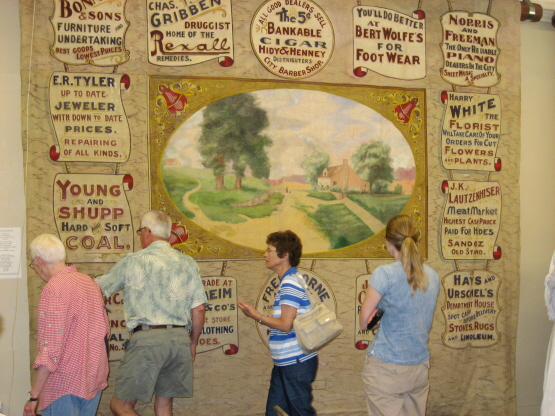
The final results were spectacular.
The restored curtain was unveiled in April and now hangs at the Center for
History. By the way, as rare as
this curtain is, we have a second opera curtain from the same era in our
collection!
Programs Inspired by the Restoration.
Restoring the 1910 opera curtain lent itself to a number of interesting
programs. Two of our monthly dinner
programs were dedicated to the opera curtain project.
In March, conservator Jennifer Hein explained the conservation process
for our curtain. In April,
Manchester College professor Katherine Tinsley presented a program on the
importance of opera houses in small towns in America.
She used research provided (thank you, Allan White) about actual programs
and events held in our opera house, and broadened the context to include the
general experience in America.
On May 13, we unveiled the restored curtain.
Manchester College opera workshop students under the supervision of Dr.
Debra Lynn presented a one-act comic opera in English to the guests who came for
the unveiling. On June 6, we
unveiled the contemporary opera curtain we commissioned
and held a thank you reception for the businesses that supported the
project and the Manchester High School students who produced the contemporary
curtain. A short program compared
the businesses on the 1910 curtain to their equivalents in 2012.
The February issue of this newsletter included a reprinted interview with local
historian Dr. L. Z Bunker from 1982 concerning the opera house and its curtain.
The rest of the issue was dedicated to excerpts from the North
Manchester Journal of October 15, 1885, which described a devastating
fire that destroyed the opera house and several other downtown businesses.
The opera house was rebuilt and opened the next year.
Contemporary Opera Curtain Commissioned.
As we restored the curtain, we realized that it had originally served as
an advertising piece, but now, 100 years later, it serves more as an historic
record of the businesses that were active in North Manchester at the time.
None are operating today, but the curtain provides a unique record of the
products and services that defined the town long ago.
We decided to commission a contemporary opera curtain and invite current
businesses and organizations to be part of it.
The NMHS provided the materials and approached businesses for sponsorship
and advertising. We pointed out
that the contemporary curtain will hang for many years in the Center for
History, next to the restored curtain.
It will document current businesses and organizations 100 years from now,
just as the 1910 curtain does.
We approached local businesses which had a business or function similar to the
ones on the 1910 curtain. Major
sponsors for the “Year of the Opera Curtain” Beacon Credit Union, Manchester
University, Poet Biorefining and Shepherd Chevrolet are featured prominently on
the contemporary curtain. Also
appearing are the Fine Arts Club, Peabody Retirement Community, Timbercrest
Senior Living Community, McKee Mortuary, Harting Furniture, and Riverbridge
Electric. Rounding out the
advertisers are KenapocoMocha Coffee House, Fahs Brown Plumbing (representing
the Manchester Early Learning Center on the curtain), First Financial Bank,
Newmarket, Creative Stitch Quilt Shop, One World Handcrafts, the Main View
Restaurant and the Firehouse Theater.
Debra Kern, art teacher at Manchester High School, agreed to take on the
project. The curtain is big and
heavy, a canvas square 14 feet by 14 feet, which made it a challenge to design
and paint. The colorful curtain
reflects the modern use of logos and brighter colors, while still retaining the
feel of the 1910 curtain. Logos
were projected on the curtain and transferred and painted by students.
The central medallion shows a scene of early 20th century
people arriving at the opera house, with a casually dressed contemporary couple
just outside the frame, watching the action but “with their feet in the future.”
Students who helped paint the curtain are Katie Durden, Hannah Lochner, Tawni
Kincaid, Paige Blocher, Krisy Mize, Evan Wilcox, Treya Paquera, Katie Floor,
Madison Isbell, Brittani Weimann, Marret Metzger, Bradley Miller, Mariah Mobley,
Claire McLaughlin, Mick Avery, D.J. Norwood, Allissa Isley, Myra Long and
Samantha Hall.
The Firehouse Follies.
On June 17, the NMHS and the Firehouse Theater presented the Firehouse
Follies. The NMHS approached this
civic theater group about presenting a review of local talent performing acts
that are similar to those that once appeared at the North Manchester Opera
House. The contemporary opera
curtain served as a backdrop in the performance space. The Firehouse Theater
folks invited community members to perform in the spirit of 1910.
Allan White provided extensive information about opera house events based on the
local newspapers of the era. For
example, a Mandolin Chorus met at the Opera House once; we had a ukulele chorus.
We know that Uncle Tom’s Cabin was a very popular touring play
that performed several times at the Opera House.
These troupes had elaborate scenery and even brought in live bloodhounds
to help chase the character Eliza when she tries to escape.
Our offering was to have a dog act—four service dogs performed simple
tricks and stole the hearts of the audience.
David Lawrenz served as emcee, introducing the acts and providing jokes and
information to keep the show moving.
He worked in information about how important the opera houses were before
the days of telephone, radio, movies, television or the internet.
The opera house was the biggest room in town, and provided a space for
entertainment, educational lectures, graduation ceremonies, and even roller
skating and basketball games.
The evening started with an hour-long concert by the Manchester Community Band.
Jim Smith followed with a stirring rendition of Casey at the Bat,
followed by the Canine Companion Tricksters:
Annabelle the Scottish Terrier under the command of Marilyn Mason, Dkyler
the Boarder Collie with Deana Davis, Breeze the Labradoodle with Susan Sharp and
Chloe the French Bulldog with Debbie Bryant.
David Moan performed songs from the Civil War, Marching through
Georgia and Just Before the Battle, Mother, followed by Toby Tobias
as Victorian wrestler Ed “Strangler” Lewis (you had to see it to believe it).
The Kruschwitz Ukulele Choir performed several numbers, highlighted by
LuAnn Harley leading the audience in a simple hula to Aloha Oe’.
After a brief intermission, the Eel River Choral Society sang My Life Flows
on in Endless Song and A Wonderful Savior is Jesus.
Local storyteller Mac McKinley read two James Whitcomb Riley poems (Riley
appeared at the NM Opera House several times), followed by fiddle tunes from the
Fiddling Kruschwitzes, Brian and sons Harley and Owen.
The evening closed with the performance of an original melodrama written for the
NMHS by Charles and Dagny Boebel, Dolly’s Dilemma, or Who Will Pay the Money
for the Mortgage on the Farm?
Sarah Hawkins Moan, David Moan and Andrew Chinworth played the sobbing heroine,
dastardly villain and hero (in all white costume) in this drama with
contemporary twists. Kathy Hawkins
cued the audience to participate with posters urging them to boo, hiss, cheer
and applaud.
A wonderful time was had by all.
Audience members asked if we could do this again next year! Please watch the
newspaper for more programs this fall that are associated with the NMHS Year of
the Opera Curtain.
Traveling Exhibits.
This year the Center for History has continued to take advantage of a
wonderful program offered by the Indiana Historical Society, traveling
historical exhibits. In May and
June, 2012, we hosted Who Do You Think You Are? an excellent exhibit on
immigration in Indiana. The North
Manchester area is fairly homogeneous in the origins of its population, but
Indiana as a whole has a very diverse population.
The exhibit was accompanied by photos, documents and maps outlining this
complexity.
During the late summer, coinciding with FunFest, we are presenting Indiana
Cartoons and Cartoonists, a subject that should be appealing to all ages.
It is available for viewing July 31 through September 4.
Our final traveling exhibit of the year is October 11 through November
14. Endangered Heritage is
an unusual exhibit because its display will be scattered throughout the Center
for History. The exhibit highlights
challenges faced by museums about how to preserve for future generations the
objects and documents that are part of our heritage.
The common dangers to collected materials are critical issues right here,
right now. Examples from our own
holdings will complement the exhibit.
Last year the Center for History brought to North Manchester exhibits on The
Care and Identification of Family Photographs, Indiana Through the
Map-Maker’s Eyes and a collection of World War II photographs, enhanced by
NMCH window displays saluting local veterans.
In the past we have also hosted exhibits on Post Office Murals and
on The Auto in Indiana. Next
year watch for exhibits on Lincoln and the Civil War as we commemorate the 150th anniversary
of that conflict.
The IHS gives not-for-profits the opportunity to display exhibits on topics of
interest in Indiana History. Their
list of exhibits includes over 20 different choices which can be booked for
approximately one month. Three
exhibits can be displayed every year for free, and the Center for History is
scheduling the maximum. We would
like the community to recognize the Center for History as the place where these
excellent exhibits are available to them on a regular basis.
You don’t have to travel to Indianapolis to see them.
Center for History Awarded National CAP Grant.
This winter, the North Manchester Historical Society applied for and
received a national grant that will provide us with a wealth of information
about how to better care for the artifacts entrusted to us, and how to utilize
our building better. The
Conservation Assessment Program (CAP) Grant is a competitive program that is run
by the Institute of Museum and Library Services (IMLS) and Heritage
Preservation, The National Institute for Conservation.
Heritage Preservation will provide funds to bring professional conservation and
building preservation specialists to the Center for History, who will identify
the conservation needs of our collection and buildings and recommend ways to
correctly improve collection and building conditions.
Their report will help us evaluate our current collections care policies,
procedures and environmental conditions.
It will help us make immediate, mid-range and long-range plans for
improvement. Some granting agencies
require a CAP assessment before an organization can be considered for funding.
The reports findings will be suggestions for planning purposes, and will
not be requirements.
We are thrilled that our conservation assessor will be Ramona Duncan-Huse,
Senior Director of Conservation and Preservation Imaging for the Indiana
Historical Society, and our building assessor will be Mary Ellen Rudisel-Jordan,
Warsaw architect with the firm Scearce-Rudisel.
Both have considerable CAP assessment experience and extensive experience
in historic preservation issues.
The assessments will take place in October, with a final report early next year.
Since 1990, 2,700 museums have participated in CAP, including museums in all 50
states. In 2012, the Center for
History is one of two organizations in Indiana receiving CAP grants.
More News from the Center
Submitted by Nancy Reed, Director of the Center for History:
New Office.
While the Center was closed over the winter months, we set up a permanent
office downstairs so that the CFH could be open more.
With the addition of two desks, a computer, printer and high-speed
internet, at the front door, we are now able to be open Monday through Friday
from 10 a.m. to 4 p.m. and on Sunday afternoons 1 p.m. to 4 p.m.
We increased our open hours from 8 per week to 33 per week, an increase
of over 400%. Now that docents have
computer and internet access, including access to our museum records, they can
help with a variety of projects that help the Center for History manage its
collection better. The response
from visitors has been phenomenal.
Thomas Marshall House Opening.
After many years of preparation, the birthplace home of Thomas Riley
Marshall is now open. Dressed in
the period style of the 1850’s the home educates visitors on what it was like to
live during that period. The home
also features the doctor’s office of Tom’s father, Daniel, and the kitchen of
his mother, Martha. Steve Batzka
looked high and low for just the right period pieces to furnish this small
house. A donation from Evelyn
Niswander, a long-time member of the project, helped us purchase furniture.
You won’t want to miss viewing it when we open it during Fun Fest.
The hours will be published.
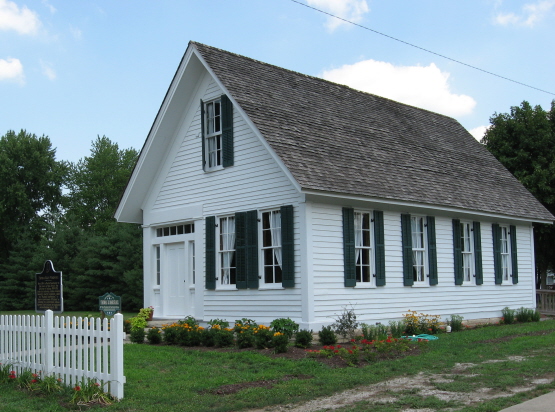
We thank all of those who worked on making this house museum become a reality
and would especially like to recognize the Community Foundation of Wabash County
for the grant we received to help furnish it.
The America In Bloom Committee made and installed the fence and
plantings, the Manchester Garden Club planted the herb garden, and Ryan Baker at
Manchester Greenhouse supplied planting materials.
Last year, the Rotary Club, capably led by Deb Brauneller, gave a fresh
coat of paint to the house and shutters.
Jim Mishler and Steve Batzka also had a big role to play in these
endeavors.
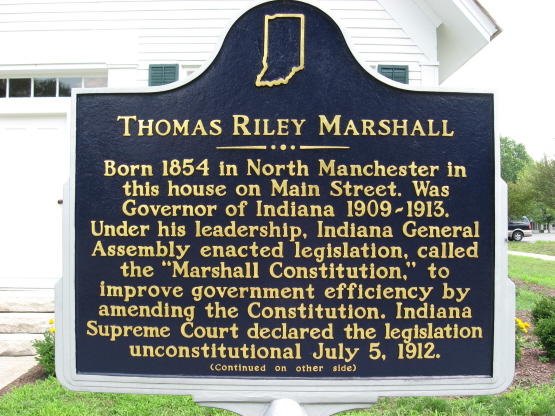
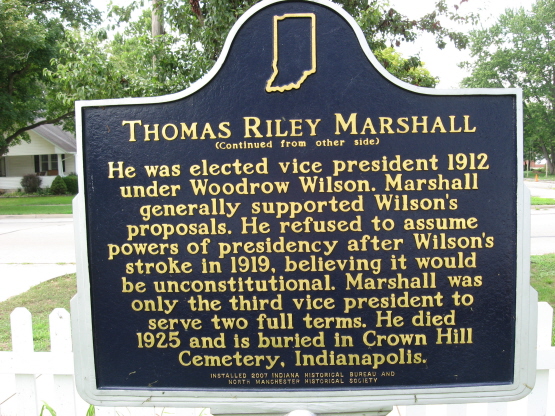
![]() 
The North Manchester Historical Society anticipates having this historic home
open monthly if several more volunteers can be found to guide visitors through
while telling its rich history.
Please call 260-982-0672 or stop by the Center for History if you are interested
in being a Thomas Marshall docent.
Gift Shop.
Our American Gift Shoppe has grown.
We now have a larger dedicated space at the front of the Center for
History with new items for sale.
Many more historic books are available including Gladys Airgood’s popular book
of Servia’s history. New items include a model DeWitt automobile (just $15), and
wooden toys crafted locally at Silver Lake, Indiana, and reminiscent of the toys
from yesterday. A variety of new
postcards are available, sold only at this museum gift shop.
Most of the souvenirs with which you have become familiar, are still
available. Our past Newsletters
are also on display for sale.
There is a fee to tour the Center for History at $3.00 per person (free for NMHS
members) since we believe that we have a quality product to show you which is
ever changing, and we need to try to cover some of our expenses.
However, visiting the Americana Shoppe is free, so stop by anytime to
find that special gift you might like to give to your visitors, past N.
Manchester alumni, or for weddings, at Christmas time, etc.
Christmas Windows and Cookie
Exchange.
Plans are under way to make this holiday season special on Main Street.
Your local merchants, the Chamber of Commerce and N. Manchester Main
Street are already hard at work planning our holiday activities for your
enjoyment.
The North Manchester Historical Society and Center for History have a new
plan for making our windows look just right for the Christmas season.
And instead of holding our annual bake sale during Fun Fest, we are
switching things just a bit and plan to hold a cookie exchange and bake sale
some time around the Thanksgiving and Christmas holidays.
Plan to participate in the cookie exchange to increase the variety of
sweets to offer your holiday guests.
Antiques Appraisal.
We look forward to offering an annual antiques appraisal here at the Center for
History. Professional appraisers
are now being contacted so that arrangements can be finalized for this program
to be held during the Harvest Festival.
If this is something you might be interested in attending, please give us
some feedback. Suggestions for
appraisers are also welcome.
Volunteer Recognition.
The month of April was National Volunteer Recognition month and the
Center for History was delighted to honor volunteers of 2010 and 2011.
Sixty volunteers were invited to a beautiful reception in their honor to
thank them for the over 7,637 volunteer hours they gave us in 2010 and 2011.
This year we recognized service to both the N. Manchester Center for
History and the Historical Society in general.
Individuals with more than 100 hours accumulated were given monogrammed
polo shirts with the Center for History logo in appreciation for their
dedication and service. The NMHS
also recognized Volunteers of the Year 2010—JoAnn Schall and John & Bea Knarr,
and—for 2011 Volunteer of the Year, Ralph Naragon.
We wish to thank the reception committee, Darlene Bucher, Eloise Eberly,
Jeanette Lahman and Dorothy Weldy, for their help in making the evening
especially lovely and tasty.
We at the Center are especially proud of the fine work all of our volunteers do.
If you think you’d like to become a volunteer, please contact us immediately.
We welcome and need more people to become involved.
You don’t need to know anything about N. Manchester’s history in order to
be helpful to us. Call today!
260-982-0672.
Peabody Mansion DVD Available.
A film titled “Journey’s End:
The Building of the Peabody Mansion” has just been released by the N.
Manchester Historical Society and is sold only in our gift shop.
This film was shot in the 1930’s by Tom Peabody himself, as the home we
fondly call the Peabody Mansion was being built.
This 60 minutes movie shows the craftsmen of that time period doing what
they were so skilled at.
While Mr. Peabody was initially concerned about going ahead with the building of
his home during the Depression era, townspeople urged him to proceed because it
would provide jobs for local tradesmen.
You won’t want to miss seeing the framers, brick layers, road paving
machines, landscapers, and many more as they helped to build this outstanding
home.
The cost of this DVD is $15 and may be ordered by calling 260-982-0672, by
emailing us at nmhistory@cinergymetro.net , or by stopping by the Center for
History at 124 E. Main Street during office hours.
NOTE: Another DVD, “See Yourself in
the Movies”, made in 1938 of the entire town and its citizens, is also for sale
at the same price.
Source: NMHS Newsletter, November
2011
North Manchester Historical Society
Highlights of 2011
Building
Celebrated 10 years on Main Street
Burned mortgage, we own building completely
Established facilities management committee
New track lights in front windows
New furnace/air conditioner on first floor
New air conditioning unit in office area
Cleaned out two back rooms for exhibit space
Removed wire and pipes for scrap sale
Painted back middle room, removed wallpaper and structures
Painted exterior back and side doors and interior bathroom doors
Water cooler and toilet leaks repaired
Installed light in garage stairway
Held 3 work days to clean and paint – M College students, board, First Brethren
Church
Exhibits and Collection
Developed and displayed exhibit on family photographs
Developed and displayed exhibit on Oppenheim family and store
Hosted 3 traveling exhibits: family
photos, maps and mapmakers, WWII photographer
Window displays on Peabody construction and fair grounds, Oppenheim family
artifacts,
local maps, NMHS photographs and cameras, veterans, Christmas
Constructed four display modules
Constructed additional free-standing display walls
Re-painted and reinforced shabby divider screens
Constructed 16 gender-neutral mannequins for use in exhibits and displays
Constructed carts for tables and folding chairs
Recorded 98 accessions (960 individual items)
Have 550 additional items not yet processed
Installed movie screen
Constructed case for tree ring display
In process of restoring rare opera curtain
Improved labeling on some permanent exhibits
Thomas Marshall House
NM Rotary painted exterior
America in Bloom installed landscaping and fence
Installed water service
Updated furniture acquisition list, applied for grant to purchase furniture
Grants
Community Foundation/Wabash County grant awarded for construction of display
cubicles
CFWC grant received for restoration of opera curtain
Grant and loan received for furnace and air conditioning upgrades
Grant application for furnace replacement in process
Final reports turned in for CFWC grants on fire extinguishers & exhibit display
cubicles
Collection Assessment Program grant application in process
Indiana Humanities Council grant application for opera curtain programs in
process
Administrative
Functioned well during about 6 months of staff absences due to health concerns
Obtained new copier with lower overall costs
Participated in Indiana Historical Society (IHS) pilot museum assessment program
Participated in Funfest and Fall Harvest Festival
Reviewed dinner reservation procedures
Loaned items and traveling exhibit to Peabody Home for anniversary celebration
Attended IHS graphics design workshop
Attended regional IHS meetings for local historical organizations
Visited sister organizations in Columbia City, Warsaw, Rochester, Huntington,
Anderson, Delphi, Shelbyville (pioneer days) and James Whitcomb Riley house
New volunteers have been cultivated for projects such as programs and exhibits
Presentations made to Peabody for anniversary celebration, and to Rotary,
Kiwanis and Shepherd’s Center
Met with Wabash County Museum staff to foster collaborative ventures
Hosted fabric conservator, reviewed collection management with her
Hosted meetings for Community Foundation of Wabash County (twice) and Rotary
Conducted tours for family and reunion groups
Programs
Another year of outstanding and varied dinner programs
Programs were well attended, with range of 82 to 150 attendees each month
Presented first annual Historic Preservation Month program with tours
Created “Behind the Scenes” Tour of Center for History
Developed program for visiting 2nd graders
with MC elementary ed students
In process of revamping programs for visiting 3rd and
4th graders
In process of developing 10 to 12 programs in conjunction with opera curtain
restoration
1938 film reviewed to increase identification of participants; in process of
updating
Preliminary opera curtain work of conservator opened to public, HS and college
students
Excursions
Two more outstanding trips, to Mississippi River and Detroit
Trips full, feedback excellent
Newsletter and Website
4 attractive newsletters mailed on time
About 20,000 hits averaged to web site each month
Web activity recorded virtually every hour from all over the world
All newsletters to date are posted at web site (nmanchesterhistory.org)
Initiated Facebook and Twitter presence
Publicity
Increased publicity in newspapers significantly this year
Revived weekly photo identification program in News Journal
Press releases for all dinner meetings, and posters for most
Press releases for special activities such as traveling exhibits and other
programs
Developing a MC student internship in public relations for Center for History
Membership
Increased membership contributions by $2,675, added about 30 new members
Initiated reciprocal benefits program with local history museums
Joined national Time Travelers program
Fund Raising
Meeting last year’s annual fund amount as of this date
Collected $548 at dinners from collection basket and meal surcharge to cover
complimentary speaker dinners and stipends/mileage
Bake sale ($724) a little less than last year, but with fewer hours and baked
items
Toy DeWitt car being created for purchase in gift shop
Commissioned copies of 1938 film:
sold about 13 copies
Oppenheim Exhibit at Center for History
By Mary Chrastil, President
August 2011
A major
exhibition on the Oppenheim family and store opened at the
Center for History on August 12 as part of the Center’s Fun
Fest offerings.
The Oppenheim Legacy:
A Perfect Fit for North Manchester for 125 Years
is based on over 600 artifacts and photographs provided in
2010 by Rick Eisenstein, nephew of Phil and Pat Oppenheim,
the last owners of the Oppenheim Department Store in North
Manchester. When
the store closed in 2000, it was the oldest family-owned
department store in Indiana.
For the exhibit, additional items were added from the
North Manchester Historical Society collection.
Mounting
this exhibit was a growth experience for the Center for
History staff and other volunteers.
We tried to do more than just put stuff on display,
but instead to tell the story of this influential family and
their long time involvement in the community.
Scores of photographs were mounted and hung; hundreds
of labels were researched, prepared and placed.
“Infrastructure” items like display cubicles and
screens were built.
Three-dimensional items were cleaned and attractively
arranged, and over two dozen narratives were researched and
written. The
following narrative gives a sampling of the variety and
amount of work that went into this exhibit.
One section of the
exhibit presents the Oppenheim Store and its employees,
including photographs of the various times the store was
remodeled over its lifetime.
This part also includes photos of a 1905 baby
contest, and ladies lined up around the block waiting to
purchase nylon stockings after World War II shortages ended.
Biographies of the owners Jacob, Ben, Isaac, Jean,
Phil and Pat Oppenheim are incorporated, as well as
artifacts from the store when it closed.
Another
section displays family artifacts and photographs, including
children’s furniture, clothing and toys, dining room
settings and linens, travel trunks and clothing, family
entertainment, and family community service, including
military service.
On view are items from Phil’s run for Congress in
1978 (including radio campaign jingles you can play!) and
photographs of the various homes where the family lived in
North Manchester, courtesy of Dave Randall and Werking
Studios and Kyle and Stacy Trick.
Throughout
the exhibit are narratives about the family and their
interests and community involvement, as well as
reminiscences about working and shopping at Oppenheims.
A grant
from the Community Foundation of Wabash County enabled us to
build large display cubicles that created “rooms” within the
larger exhibit space.
The cubicles can be moved and used for future
exhibits, for example building a display “room” within one
of the larger Center for History exhibition areas.
Jim Garman, Owen Sommers, and Richard and Althea
Miller designed, built and painted the cubicles.
Assistance from Terri Michaelis and the Eel River
Watershed Project helped us produce the oversize photo
prints that add so much to the exhibit.
Carole Miller-Patrick helped pick the items to be
displayed, and plan and construct the display areas.
The
photography exhibit previously in the display area was moved
and remounted by Chaz Bellman, Alex Day, Dalton Day, Hannah
Thomas and Sabine Thomas.
Hannah and Sabine also painted display walls and
researched and produced exhibit labels.
Alex, Dalton and Levi Richardson helped move
artifacts from the collection area to the exhibit area
Jeri Kornegay helped us name the exhibit, and Beth
Anderson helped prepare displays and, with Owen Sommers,
design and build mannequins to display clothing.
Steve Lambert assembled the pedal car used by Phil
Oppenheim as a child; it’s something special, and is
currently displayed in our front windows.
Also
making contributions were James R.C. Adams, Steve Batzka,
John Knarr and Allan White.
Mary Chrastil headed the project.
Mary, Joyce Joy and Nancy Reed were involved in every
aspect of mounting the exhibit and were the key authors of
its success.
The
Oppenheim Exhibit will be on display through 2012.
After that, a major portion of it will become part of
the Center for History’s permanent displays.
Tenth Anniversary
and Mortgage Burning
On March
26, the North Manchester Historical Society celebrated two
happy events.
First, we celebrated our ten-year anniversary at the former
Oppenheim Department Store building.
The Oppenheim store closed in October, 2000.
The building was purchased by the Historical Society
in December, 2000.
The Society had been exploring various options for
relocating its collection from the Town Life Center (former
Thomas Marshall School) when the building became available.
The collection was moved to this site in the spring
of 2001.
The new
location was of great benefit to the Society and to the
community.
Rather than having three empty store fronts downtown,
interesting and attractive window displays appear three or
four times an year.
The community has used the building for receptions,
reunions, and special events, and the Historical Society
happily participates in community events such as Fun Fest,
Harvest Festival, and the Bunny Hop.
It was a
leap of faith to purchase the structure.
Many wondered if the building was too large, thinking
that we would never fill it.
At that time, the Historical Society had
approximately 2,200 items in its collection.
Today, the collection boasts of over 23,000 items!
During Fun Fest this summer, we were hard pressed to
find space for our special exhibits, traveling exhibit,
movie screening, entertainers and bake sale on the main
floor.
Collection storage and administrative space take up the
upstairs, and we are starting to explore the lower level for
additional gallery space.
We have had no problems filling the building!
And we are very pleased that the community trusts us
to conserve, interpret and exhibit their treasures from the
past. Special
thank you to the Harold and Eleanor Miller family for their
donation of 1,200 farm-related artifacts in 2009, and the
family of Phil and Pat Oppenheim for the donation of over
600 artifacts from the family and store in 2010.
The
second thing we celebrated was burning our mortgage on the
Oppenheim Building.
Our final mortgage payment was made in January, 2011.
President Mary Chrastil noted that she had often
heard of mortgage burnings, but had not experienced such a
ceremony personally.
She then lit up a copy of the paid up mortgage for
all to enjoy.
The NM Historical Society now owns the building free and
clear, in only ten years and one month.
Thank you to all who have contributed to our efforts,
with a special thank you to the Paul Speicher Foundation.
Opera
Curtain to Be Restored
The North
Manchester Historical Society is very pleased to announce
that we have received a grant of $2,000 from the Community
Foundation of Wabash County to help with the restoration of
a rare Painted Theatrical Backdrop in our collection.
We commonly refer to such backdrops as opera
curtains.
The
curtain was donated by J. P. Freeman.
We contacted the Indiana Historical Society for
information, and they referred us to textile conservator
Jennifer Hein to get an estimate for the restoration.
She told us something very interesting.
Painted theatrical backdrops are very rare!
Because they are painted on fabric and because they
were often folded up or rolled up, they were prone to
cracking, rot, mildew and mold.
She told us she knew of only one other organization
in Indiana that had a backdrop; we have since learned of two
others. Based on
photographs, she thought ours was an excellent example based
on the quality of its artwork and the brightness of its
colors.
The grant
will cover a portion of the $6,500 cost to stabilize and
restore the backdrop.
We have also received a private donation of $1,000
toward the project.
We hope to bring Jennifer Hein to North Manchester
this fall to begin the project.
Since we
have this unexpected treasure in our museum, we decided to
make it the centerpiece of our programming for the coming
months. Ms. Hein
has agreed to allow the general public and high school and
college art and history students to observe her work on a
limited basis.
Watch for announcements on when the observations are
scheduled.
Next spring, when the
opera curtain restoration is completed, we plan on a series
of programs centered around it.
Sample programs may include performances by
historical interpreters and opera students, lectures on the
businesses listed on the opera curtain, and lectures on the
North Manchester Opera House and performances held there,
and a lecture on the Chautauqua Movement in the 19th and
20th century.
By the
way, as rare as the opera curtain is, we have the good
fortune to have TWO of them in our collection!
You have no doubt seen the one on display, which
could use some conservation work, but which is in good
condition overall.
Charles Boebel wrote an informative article on this
curtain published in local newspapers last fall.
Who knew that the opera curtains were so rare, and
who would have believed that we have not one, but two, of
them!
Traveling
Exhibits
The
Center for History is taking advantage of a wonderful
program offered by the Indiana Historical Society.
The IHS gives not-for-profits the opportunity to
display exhibits on topics of interest in Indiana History.
Their list of exhibits includes over 20 different
choices. Three
exhibits can be displayed every year for free, and the
Center for History is scheduling the maximum.
The exhibits can be booked for approximately one
month.
Our first
exhibit was displayed in March, and featured The Care and
Identification of Family Photographs.
Because the exhibit was a two-dimensional display, we
decided to enhance it with items we have in our own
collection. We
found 160 photographs, cameras, stereopticons, and other
items! We have
tintypes, daguerreotypes, and a rare ambrotype.
We didn’t know what cartes de visite and
cabinet cards were until we hosted the exhibit; but we found
we had some in our collection!
In fact, we had an example of every item mentioned in
the exhibit. The
exhibit that we added worked so well that we decided to keep
it on display.
You can see The Care and Identification of Family
Photographs at the Center for History through the end of
the year.
We just
finished our second traveling exhibit of the year,
Indiana Through the Map-Maker’s Eyes.
To enhance the 20-panel display, we exhibited maps
and globes from the NM Historical Society collection.
Although the traveling exhibit is gone, the maps and
globes are on display in our front windows through October.
They include some interesting Sanborn maps of North
Manchester, originally made for insurance purposes but now a
treasure trove of information for historical research.
This
year’s final traveling exhibit will be on display from
October 17 through November 18, and will feature the World
War II photographs of Indianapolis resident John Bushemi.
Our windows will display a salute to local veterans.
The
Center for History has brought IHS traveling exhibits to the
community before.
Some years ago we hosted exhibits on Post Office
Murals and on The Auto in Indiana.
We would
like the community to recognize the Center for History as
the place where these excellent exhibits are available to
them on a regular basis.
You don’t have to travel to Indianapolis to see them.
Expect more traveling exhibits next year.
Thomas
Marshall House News
This
spring, the North Manchester Rotary decided to paint the
Thomas Marshall House as its community project.
It had not been painted in several years, and
chipping and flaking were becoming more and more apparent.
Rotary
members and a group of Historical Society representatives
met and decided that the logistics of using all-volunteer
painters was just too complicated, as it would involve
constructing scaffolding and taking it up and down over a
period of several weeks while volunteers painted.
The most cost effective and simple way to proceed was
to do some volunteer work on the house, but hire a
professional painter to do the painting.
The total cost was a bit over what the Rotary had
budgeted, but the job was accomplished with contributions
from the Historical Society, a little extra from Rotary, and
a great price from the painter, Historical Society Member
Jim Mishler. It
looks great!
Some of
the work was done by volunteers.
Rotary arranged to have the house power washed.
North Manchester Historical Society member Steven
Batzka was in charge of scraping and painting the shutters,
which are too delicate to withstand a power wash.
Deb and Brad Bauneller from Rotary (and also
Historical Society Members) put the shutters back up.
We’re all set for many more years.
Another
Thomas Marshall House project will be taking shape this
fall. America in
Bloom plans to plant a garden of old-fashioned plants around
the house, such as day lilies, peonies, and hydrangeas.
An herb garden is also being considered.
Watch for fall plantings and spring blossoms next
April.
Thank you
to Rotary and America in Bloom for adopting the Thomas
Marshall House and improving the property.
The Historical Society plans to open the house with
regular visiting hours in spring, 2012.
Our main concerns now are additional furnishings,
creating a small exhibit on Thomas Marshall for the house,
and securing docents who can provide tours and information
during open hours.
Your help with any of these areas would be welcome!
Call Nancy at 982-0672.
Spruce Up, Clean Up
By Nancy Reed, Director
August 2011
The
opening on March 19,
2011, was preceded and followed by many volunteer hours of
cleaning, painting, carpenter work to get new areas ready,
moving of showcases and just good old elbow grease.
A group of Manchester College students helped us to
remove wallpaper and paint the north room.
They also assisted in removing the displays in the
front windows and removing the tape adhered to those
windows.
Mary and Joyce carried most of the load on organizing and
supervising this one and several that followed.
I was in and out of the hospital with tests and
broken wrists (one in November and one in May).
[Just so you’ll know, I’m all well again and back to
work.]
Next came a town-wide clean up day when many of the churches
volunteer during Sunday morning services to go about town
cleaning up. In
our case, a group from the First Brethren Church picked us
to help and we divided them among our 3 floors and got a lot
done to organize and clean things out.
Some washed our display windows, inside and out.
Some helped us clean out the garage, and there was
much carrying of heavy items to the basement.
Another group swept cobwebs, replaced light bulbs and
handled the dirty work of sprucing up the basement storage
area. A couple
of brave ladies attacked the archival storage shelves on the
second floor with dusters and a shop vac.
We didn’t get everything done (as we hoped might be
accomplished), but enough that we felt it was a grand
success. It
might be compared to the olden days when your aunts, uncles,
and grandparents did spring and fall house cleaning.
Do any of you still do this?
As for the rest of it, it will have to wait for
another day. Any
volunteers?
Activities continue and we’re busy planning so much for the
rest of the year and for 2012.
You would be amazed at what our small staff
accomplishes.
Stop by to see for yourself.
[And bring some friends or family with you!]
Big
Bake Sale
2011
was our third year for holding a bake sale as a fund-raiser
for the North Manchester Center for History.
With so much to do in preparing the Oppenheim
exhibits, we found just the team of volunteers to take over
the organizational part of putting on a bake sale.
Judy Glasgow, Nancy Schuler, Carolyn Reed, Loree
Pritchard, Jeanette Lahman, and Bonnie Merritt capably did
the phone calling for baked items,
getting workers for the sale, and working at the sale
itself.
As for the baked items, and I say this every year, they were
better than ever!
Seriously, the talent for baking has not been lost
over the years.
The pies were numerous and scrumptious.
The cookies, fudge and brownies were hits with the
children. Lots
of people purchased the snack mixes in individual baggies as
they walked by our outdoor table during the Friday night
“Cruise-In”.
Breads, yeast rolls, Danish pastry, muffins and cakes were
grabbed up in no time at all.
We started out overflowing three long tables and the top of
a long showcase with baked items.
By the end of day one, we were down to two tables and
by closing time on Saturday, everything was sold.
Total profit for the Center for History was nearly
$725. All
of it will go into our annual fund budget to offset costs of
running the Center for History.
Thank you workers:
Bea Knarr, Mary Miller, Phyllis Pettit, B.J. Grube,
JoAnn Schall, Sally Welborn, Betty Hamlin, Peggy Gilbert,
Cass Amiss, Loree Pritchard, Julia Hoover, Arlene Deardorf,
Karen Hewitt.
Thank you bake sale committee, thank you Barb Amiss, Nancy
Tiger and Nancy Schuler for putting in extra hours, and
thank you Fun Fest attendees for buying from us.
We’ll be back next year.
“See
Yourself in the Movies” Project
Many of you have seen the 1938 Tri-Kappa movie “See
Yourself in the Movies”.
In case you haven’t heard of it, it was film shot by
a professional photographer in 1938.
The Tri-Kappa group in cooperation with the Business
and Professional Women, arranged for movies to be shot on
specific days in North Manchester.
It was advertised in the local newspaper and the
community was urged to turn out and be ready for the
photographer to come to their workplace, church, school or
business locations.
A few years ago, Jim Adams and Charles Boebel did a
voice-over to the originally silent film, by identifying as
many of the people as they could.
The Historical Society is now undertaking a project
to identify even more people in the film and then Jim and
Charles will revise the script and add many more
individuals.
We held the first of those screenings at the Center during
Fun Fest and many turned out to watch the movie and help us
with identification.
A hundred or more names have already been added.
We plan to meet at Peabody and Timbercrest and with
other individuals so some long-time North Manchester
residents can help us identify even more folks.
If you believe that you could help us, or if you’ve
seen the film and recognized anyone, won’t you please call
the Center for History at 982-0672 or Nancy Reed at 982-2858
and we will be grateful for your input.
The revised 1938 movie will be sold on DVD, but
probably not until next year.
Meanwhile, if you haven’t seen the movie, but would
like to, copies are available for $15.00 by contacting the
Center for History.
Group showings might be scheduled if you call to
arrange it. Do
so quickly, because our deadline to cut off the
identification process is November 1.
A
VERY SPECIAL THANK YOU
to Owen Sommers who volunteers his extremely gifted talent
of carpentry for so many numerous projects for the North
Manchester Center for History.
He always comes when we need him.
He always has a solution to our dilemmas.
He frequently saves us money by making it work with
what we have. He
is dedicated and gets the tasks done immediately.
He wants to help others in
his retirement years
and he is always happy and gracious. We couldn’t do the
projects without you, Owen.
Thanks!
YOU
CAN HELP. HERE
ARE SOME OF OUR NEEDS.
Someone to clean and wax our tile floors with a
professional machine.
This is heavy duty work.
We will supply the products if you will supply the
manpower.
Used overhead cabinets (3 or 4) for our small kitchenette.
Volunteer docents for one Wednesday or Saturday each month,
between the hours of 10 a.m. to 2:00 p.m. for the Center for
History. We will
teach you what you need to know.
If we had more docents, we could open more days and
hours. We like
for docents to work in pairs, so bring a friend or we will
match you up with another volunteer.
Volunteer docents and interpreters for the Thomas Marshall
house. We will
need to teach you about the Marshalls and the times around
1850. You will
need to be available at least once a month to give guided
tours and tell the stories of Thomas Marshall and North
Manchester.
Add your name to a list of people we might call to help us:
painters, carpenters, those willing to move heavy
objects, cleaners, decorators for window and museum
displays. We also need someone with excellent computer
skills to assist with accessioning artifacts, keeping track
of income and expense items on spreadsheets, working with a
membership data base, fundraising mailings, and much more.
Just call the Center for History to have your name
added to our list.
This is part-time, irregular work at your
convenience.
Volunteer to set up a facebook page for us and maintain it.
We are searching for anyone interested in serving on a
committee regarding historic house signs.
The current signs are in disrepair and we want to
update and replace them.
Many more homes deserve to receive a sign and this
will need to be researched.
Also, the covenants for receiving and keeping a
history house sign need to be revised.
To volunteer, call the Center.
To volunteer call the Center for History at 260-982-0672 or
Nancy Reed at 260-982-2858.
North
Manchester Historical Society to Participate in Pilot
Program
The staff
and board of directors will be participating in a piloting
assessment for the Indiana Historical Society this fall.
We were one of a few museums to be matched up with
one other similar museum around the state to assess one
another. North
Manchester has been matched with the Madison County Museum
at Anderson, IN.
They will be critiquing and learning from us and vice versa.
If all goes well, this is a project that will be
offered around the state.
We feel lucky to have been selected.
News
Notes
December
– See our special Christmas windows, always grand and
colorful. We
hope to do a display of dolls from various eras.
If you have a collection that you would be willing to
loan, please contact Nancy Reed at 982-2858 or the Center at
982-0672.
Tours –
we have group tours being booked throughout the year.
Would your church group, graduating class, social
club, family reunion, anniversary party, or friends and
relatives like to see and hear about our exhibits?
Ask us about our special rates for group parties.
Then call to book a tour with us.
We’ll be glad to tailor your tour for whatever your
time limit allows.
It takes a minimum of one-half hour to see
everything—fast.
An hour is better and 1-1/2 hours will be filled with
historic facts and stories that we’re certain you will
enjoy. Touring
the Center for History is a very nostalgic trip.
Another part of your tour can be to visit the second
floor to see how we archive and store our over 23,000 items
and know where they are when we need to retrieve them.
At the
request of Manchester College we have added their African
Art collection to our storage area.
We anticipate getting a grant that will help us
restore and stabilize this collection and hope to build a
special humidity controlled area in our basement to display
these valuable items.
We expect the process to take more than a year to
complete, so stand by for more details of our progress.
Watch for
the release of a new hand-made, DeWitt model car.
It is made of wood, is very durable and just right
for giving to a child.
They may be available for Christmas.
New
projects pop up daily.
We never know what opportunity is going to present
itself, but we look forward to them.
They make our museum ever-changing and always
interesting.
CENTER FOR HISTORY CELEBRATING 10-YEAR
ANNIVERSARY
This month (March 2011) the North Manchester Center for
History will be celebrating its 10th year in the former
Oppenheim building. We are proud to announce that during
this 10-year period our collection has increased from 2,200
items to nearly 23,000 documents, artifacts and local
historical treasures. This article highlights the humble
beginnings of the collection and some of the people that
made it possible.
As early as the late 1960s, articles of historic worth
were stored on the third floor of the city hall building.
Though not organized in a formal display, these items were
available for public viewing on a limited basis. At some
point the items needed to be moved and were stored above the
Wible Shoe Store (Burge Building) on Main Street, site of
the current AT&T wireless store. By 1972, the North
Manchester Historical Society organized under the able
leadership of Max and Sally Allen. Items of historical
interest continued to be collected by this group and by the
sesquicentennial year collections were very active and
publicly solicited. In 1984, with the growing number of
items, an organized method of logging accessions was
adopted. In 1990, two former classrooms in the Town Life
Center (formerly Thomas Marshall School) were rented by the
Historical Society to once again display and store the
artifacts. Max and Grace Kester supervised the creation of
attractive educational displays. Rosemary Manifold and
Catherin Smith were in charge of accessions for many years,
and the collection continued to grow with the addition of
donations from the general public. This are of the Town Life
Center was given the name, North Manchester Historical
Society Museum. Phil Orpurt became quite active as curator
of this museum and spent many long hours collecting,
recording, displaying an preserving items for future
generations to enjoy.
With a need to vacate to Town Life Center classrooms and
the growing pains of available space, an advisory committee
of the historical society was formed consisting of David
Grandstaff, Emerson Niswander, Jim Adams, Steve Batzka,
Shirley Mishler, Dick Miller, Mary Chrastil, Steve Hammer,
Ferne Baldwin and Ralph Naragon. This committee focused on
finding a new home for the museum. While their meetings and
fact-finding progressed, the Oppenheim Store came up for
sale. The Oppenheim Store, a staple in North Manchester for
125 years, began in 1875 with Jacob Oppenheim opening the
Oppenheim New York Cheap Store.
In 2000, negotiations began and progressed to the
purchase of the site in December 2000; the collection was
moved in 2001. Emerson Niswander helped secure Oppenheim
store artifacts for the collection during the auction when
the store was liquidated. Countless volunteer hours and
hired contractors began to prepare the Oppenheim building
for housing the 2200 items that had been collected. A
specially chosen Museum Committee consisting of former
advisory committee members, Mary Chrastil, Steve Hammer,
David Grandstaff, Ralph Naragon, and with the addition of
Arthur Gilbert, Phil Orpurt, Bonnie Ingraham, Tim Taylor and
Robin Lahman began to steer the museum into the 21st
century.
Jeanne Andersen served as Director as collection
information was transferred to professional museum software
and labeled using standard museum techniques. Key volunteers
were Bernice Ford, Eunice Butterbaugh, Joyce Joy, Debbie
Chinworth, Carolyn Leffel, Ann Curtis, Evelyn Niswander and
Ferne Baldwin. Window displays were established, several
special temporary exhibits were presented, and planning was
done for permanent exhibits. Under the leadership of Bill
Eberly, in 2007 the Center for History established regular
hours when the public could view exhibits. At that time,
Nancy Reed became Director. The full circle had been made,
as Nancy had been instrumental in storing and exhibiting the
small collection housed in the City Hall building so many
years before.
Several "mini" collections have been key additions to the
overall collection. Ferne Baldwin and Bill Eberly were
influential in obtaining items that had been stored at
Manchester College or were in the College Museum. The Harold
and Eleanor Miller family donated over 1,200 farm related
artifacts collected over four generations. And the family of
Pat and Phil Oppenheim recently donated over 600 items from
that family.
Today, in 2011 we celebrate the goal of paying off the
mortgage on the museum. On March 26, the Historical Society
will host a reception, behind-the-scenes tours of our
building and extensive collection, and a mortgage burning.
The Board of Directors of the North Manchester Historical
Society feel the museum is an attractive new asset for Main
Street and an important step for the society and the town of
North Manchester. We are pleased that the community trusts
that the Historical Society will take good care of its
memories and artifacts, as demonstrated in the rapid growth
of our collection.
To donate items for consideration, contact Joyce Joy,
curator, at 982-0672. You can also visit us at 120 E. Main
St., North Manchester; or at
www.nmanchesterhistory.org.
Submitted by Mary Chrastil, President (2011),
North Manchester Historical Society.
Source: The Paper, March 9, 2011
North
Manchester Historical Society
By William R. Eberly, January 28, 2010
The North Manchester Historical Society began in 1972 with
twelve members. In just two years the membership had
grown to a hundred and twenty-five. The first major
project was to have a rededication of the covered bridge in
North Manchester, which was built in 1872. This is one of
the most northerly covered bridges in Indiana left in its
original location that is still usable. .
The Society began publishing a quarterly Newsletter in 1984,
which continues to this day. Each issue is sixteen
pages and is usually illustrated with pertinent photographs.
The latest issue is dated November 2009 and represents
Volume XXVI Number 4. That’s more than 1600 pages of
mostly original articles and notes.
Thomas R. Marshall, Governor of Indiana 1909-1913 and
Vice-President of the United States under Wilson 1913-1921,
was born in North Manchester in 1854. The house still
survives even though Marshall does not! The house was
moved three times. About 1992 the last private owners
decided to either sell or raze the house. The
Historical Society bought it and moved it in 1994 to a
fourth location on town property adjacent to the Public
Library. Efforts were made to restore the house to its
original 1850 condition and to locate some furnishings of
the 1850s. It was dedicated August 12, 2005. A
historical marker from the Indiana Historical Bureau was
installed and dedicated August 10, 2007.
In 1909 a small factory along the railroad at the west end
of town began manufacturing an automobile, the DeWitt.
It was a high-wheel buggy type of car. Various labor
problems and a major fire closed the factory in 1910.
It was never rebuilt. Two young men in North
Manchester built a replica of the DeWitt that would actually
run on the open road. Their car was presented to the
Historical Society in 1973. These same two men
produced about fifteen additional replicas, many of which
were sold to theme parks, theater groups, etc. A few
models were battery-powered for use indoors. There is
only one original, unrestored DeWitt in the world, and we
hope to have it on display at our museum, some time.
We want to promote the DeWitt as one of the key icons of
North Manchester.
The Society began collecting artifacts relating to North
Manchester and early pioneer life in the area. We had
never had a very good location to display this collection.
Finally, in 2001, we bought the old Oppenheim store building
on Main Street to develop as a museum. This was one of
the best known stores in Northern Indiana for a century or
more. There is a display area on the first floor of
ca. 11,000 sq. ft., plus additional space on the top floor
and basement of 18,000 sq. ft.
When we moved into the “new” old building, we had about
2,000 catalogued artifacts. Much work on the
infrastructure of the building was needed.
Implementing a system for accessioning and storing artifacts
delayed the development of the public viewing space on the
main floor. After we had a grand opening of the museum
display hall in 2007, we began to receive many more items.
Just recently our Office Manager said we now have nearly
20,000 accessioned items. We have many items yet
to be processed.
We are now in the process of setting up a web site for the
Historical Society. It can be accessed through
www.nmanchesterhistory.org . We publish a
short historical essay every month or so in the local News
Journal. About fifteen such articles have appeared so
far.
From the beginning the Historical Society had monthly dinner
meetings followed by a program. After a number
of years interest and attendance dropped to a few dozen or
so. For the past two years, there has been a significant
increase in numbers attending our programs. We are
averaging now about 80-100 at our programs; once we had
about 220 and another time 140 in attendance. Many
people come to hear the program who do not share in the
dinner.
The museum is closed for about three months during the
winter, though when there are requests we gladly open it to
special groups and other visitors. At the official
reopening, usually in March, we have been having a special
program event for children. It was called a Bunny Hop
or Hop Into Spring. Co-sponsored with the Tourism
Committee of the Chamber of Commerce, there are live animals
present for the children to pet (chickens, ducks, rabbits,
lambs), art contests with prizes, a photographer to take
pictures of the children with a giant bunny rabbit (in
costume), planting seeds to take home, etc.
We are fortunate in having the elementary school
(representing two townships) close, even within walking
distance. We have scheduled several kinds of events
and activities with the children. This year the fourth
grade students came by classes (there were five classes of
4th graders) and were given special tours of the museum.
Docents led small groups (6-7 students) through the
exhibits.
Also this year, in cooperation with a planning committee of
teachers, we provided a series of interactive work stations
(about 15 or so stations) for the third grade students.
These centers featured historical and practical activities,
such as paper modeling (origami), how to set a table, how to
sew on a button, how to pound nails and drill holes
(carpentering), playing marbles and jacks, etc. Each
student worked out a ticket to get involved in five
activities, so at any one time there were only two to five
or six at one place. They would spend about five to
ten minutes at a station. Surprisingly, this event was
a great success with these third graders. Though they
did not come to see the museum exhibits, they did look
around. More importantly, they did have a real good
time “at the museum” and enthusiastically expressed interest
in returning. We also hosted the second graders to
some special activities in the museum. Often the
children return with their parents to see the museum.
In 2007, fourth grade students around the state were
challenged to study a significant building in their
community and construct a model of that building, which
would then be entered into competition with other student
projects. One of our local fourth grade teachers
picked up on that idea. His class studied the history
of the Thomas Marshall birth house, already mentioned above.
Various members of the Historical Society assisted them in
that study. The class then picked a committee of five
students who constructed an actual model of the Marshall
house. In the state competition at Indianapolis, their
exhibit placed third. They gave their exhibit to the
Museum (where it is now on display) and also donated their
prize money to the support of the Museum.
In 1938, the Tri-Kappa Sorority sponsored a film production
titled “See Yourself in the Movies”. It was taken at
various places about town, showing many people, businesses
and random footage during special town events. Several
Society members are planning to repeat this kind of filming
now about 70 years later. Both of the two films will
then be recorded on a DVD for sale by the Society.
An affiliate of the Historical Society, the Manchester
Historic Homes Preservation Group, has purchased several
significant historic houses that were in danger of
destruction and has restored them with the help of Historic
Landmarks. They are now proposing to work on a third
building in North Manchester downtown, the very visible
Cigar Factory.
The Manchester College Art Department has agreed to provide
an intern who will spend about 15 hours a week assisting in
a variety of tasks at the museum. These students
will be taking a course in museum management of which the
internship is a vital part. The student will be
exposed to all facets of museum work. The work
is monitored by the Art Professor and the student is
supervised directly by the staff at the museum. We had
one intern in the fall semester of 2008 and another in the
spring of 2009. They made valuable contributions
to our museum program.
We are also cooperating with another program at Manchester
College. A biology professor has received a large
grant ($1,000,000) to study erosion and pollution of the Eel
River as it flows through and near North Manchester.
Our part is to serve as an educational center for various
aspects of the study. The first part of the museum
display will be a 3-dimensional model of the entire Eel
River Valley. In real life, the Eel River is about 100
miles long and drains about 815 sq. mi. The model is 8
feet long and the carving of the valley is taken directly
from USGS topo-graphic maps. This project is being
carried out by the Art Professor mentioned in the above
paragraph. A wheeled cabinet or base for this display
was delivered on December 23, 2009.
We have been assisted by a number of local merchants and
businesses. One special gift should be noted.
The local bindery and book conservator (originally the
Heckman Bindery and now owned by the HFGroup) set aside
$5,000 for our use of their services over a five year
period. We now have an extremely rare map of Wabash
County being restored by their experts.
We cooperate with a number of civic and service
organizations in town. We are especially close to the
Chamber of Commerce. Each year the Chamber sponsors a
great festival, called the FunFest. This year the
theme was “Under the Big Top”. We invited Mr. Tom
Dunwoody, the Executive Director of the International Circus
Hall of Fame at Peru, Indiana, to speak before our regular
meeting on July 13, 2009. Our display windows at the
Museum were filled with Circus models and memorabilia.
We had a Big Bake Sale. We had two DeWitt replicas on
display, one a two-seater, four passenger electric model.
And, of course, we had the museum open during the entire
festival.
A local committee (including some Historical Society
members) helped prepare North Manchester for participation
in the America in Bloom competition in 2008. We were
entered in the 5,000 to 10,000 population category.
North Manchester was awarded first place (in the nation,
among those towns that entered the competition). We
were awarded a plaque and trophy for this honor.
North Manchester received a “Special Recognition” for its
Historic Preservation. Out of a total of 125 points in this
section, we received a score of 115. To quote the
local News Journal, the Judge said “that the heritage of
North Manchester is one of its strongest areas. She
applauded the hard work of the Historical Society in the
creation of its museum. She commented on the
well-maintained collection of historical archives and
beautifully constructed displays in the museum. She
also extolled the efforts of the ongoing Thomas Marshall
Birthplace Home project, citing it as an ‘important piece of
history worthy of its ongoing preservation efforts’.
“National AIB spokesperson Laura Kunkle explained further
why Manchester was given special recognition for its
Historical preservation: “Few towns of this size can
boast a 29,000 sq. ft. museum with more than 16,000
artifacts. The Historical Society uses
state-of-the-art techniques to document and preserve this
town’s rich heritage. Displays and vignettes have been
created by volunteers and feature excellent interpretation.”
We were more than pleased by these glowing commendations
from a national organization.
Most recently, in fact the first of October, the Indiana
Historical Society announced that they had selected the
North Manchester Historical Society to receive the 2009
Outstanding Historical Organization Award. This award
is made annually to a local or county historical society,
organization, or site in Indiana which has demonstrated
remarkable public services and programs to its community.
The award was presented at the Founders Day Dinner at
Indianapolis on Monday, December 7, 2009. This is
quite an honor for our Society and our Town.
On January 28, 2010, the North Manchester Chamber of
Commerce honored us with the 2009 Community Spirit Award.
It was given based on “your innovation, your commitment, and
your contributions, which have greatly impacted the
character of our community.” Again, this recognition
from our own community is much appreciated.
As mentioned before, all of our work is done by unpaid
volunteers except for the recent addition of a worker
supported by the National Able Network SCSEP program.
Two of our volunteer workers must be named. Nancy Reed
serves as the Director of the Museum and is in charge of the
exhibits and program. She spends countless hours each week
in this role. Joyce Joy is the Office Manager and
takes care of receiving, cleaning, accessioning and storing
all artifacts as they come to the Museum. In addition,
there are several dozen volunteers who help in a multitude
of ways. Some help in the office, some serve as
docents during the open hours, some do carpentry and other
physical tasks.
A museum committee was established in 2001 to plan for the
development of the Center for History. The committee
included Mary Chrastil, chair; Art Gilbert; David Grandstaff;
Steven Hammer; Bonnie Ingraham; Ralph Naragon;
Phil Orpurt; Tim Taylor; David Tranter;
and Robin Lahman. Jeanne Andersen was employed as
project manager, later Director of the Center. She
served in this capacity until 2007. The Board also
employed Bill Firstenberger of Winona Lake, Indiana, a
professional museum planner, as a consultant. Prior to
the move to the Oppenheim building, Phil Orpurt had served
as curator of the collection for a number of years.
From the beginning, the following have served as president
of the Historical Society: Max and Sally Allen;
Al and Ruth Anne Schlitt; Steve Batzka; Robert
Nelson; Gene Graham; Duane Martin; Keith
Ross; Ramona Miller; Max Kester; Nancy
Reed; Ferne Baldwin; and Bill Eberly.
We have a Board of twelve elected members plus three ad hoc
members. The present Board of Directors includes Bob
Amiss; A. Ferne Baldwin, v.president; Darlene Bucher;
Mary Chrastil; Bill Eberly, president; Art
Gilbert; John Knarr; Mike McKee; Karl
Merritt, secretary; Viv Simmons; Tim Taylor;
Joe Vogel; Nancy Reed, director; Joyce Joy,
office manager and custodian of artifacts; Ralph Naragon,
treasurer. Many volunteers work at various tasks in
creating and building displays, hosting visitors, and
planning and leading program events.
William R. Eberly
January 28. 2010
|